
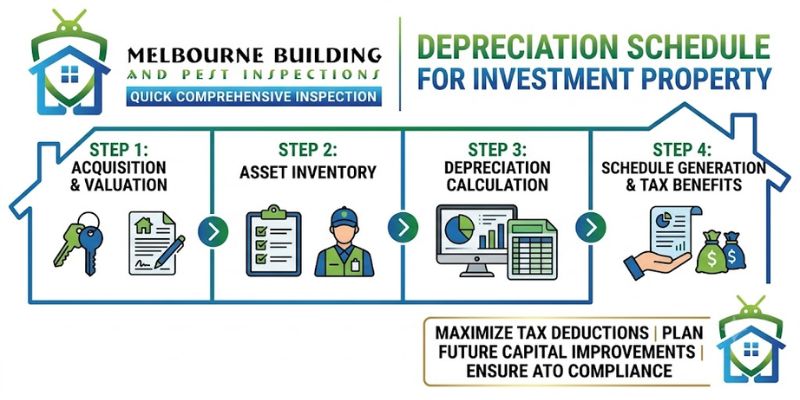
Investing in real estate gives you long-term financial benefits like rental income and property appreciation, plus valuable tax write-offs. A big money saver that Australians often ignore is claiming depreciation. Getting a depreciation schedule for investment property in Australia could mean tapping into lots of cash you might otherwise lose out on. Many homeowners let this benefit slip through their fingers due to confusion about tax depreciation. This blog breaks down what a depreciation schedule means, how it functions, and why it is wise for every property investor to get a pro’s opinion from a quantity surveyor.
Well, it’s a thorough report showing all the depreciation deductions that are available for an investment property throughout its useful lifespan.
It details which assets and parts of the building can be claimed based on their decreasing value because of normal wear and tear. Claiming these deductions happens yearly when you file your taxes.
| Component | Description |
| Capital Works | Structural elements such as walls, roofs, floors, and foundations |
| Plant and Equipment | Removable assets such as carpets, blinds, appliances, and air conditioners |
| Effective Life Estimates | Expected lifespan of depreciable assets |
| Annual Deduction Values | Estimated depreciation claim for each financial year |
A professionally prepared depreciation schedule for investment property in Australia can cover deductions for up to 40 years in some cases.
Tax depreciation is about a property’s structure and assets losing value over time due to wear and tear. Aussie tax rules let investors deduct this loss from their taxes. Generally, there are two types of depreciation you can claim.
Firstly, capital works deductions cover the building itself and big improvements. Things like walls, roofs, floors, driveways, and built-in cupboards. Secondly, plant and equipment depreciation is for removable items such as air conditioners, carpets, blinds, appliances, and hot water systems. To know what you can claim, a depreciation schedule does the math and lays out those deductions clearly.
These deductions apply to removable assets such as:
A comprehensive depreciation schedule for investment property Australia identifies both categories and calculates the allowable deductions.
Property investors often overlook depreciation when they concentrate on rental income and how much their property value might increase. A depreciation schedule, though, can help them take full advantage of all the deductions allowed by Australian tax laws.
This special report cuts taxable income, improves cash flow, finds every eligible depreciation claim, gives support for tax compliance, and offers long-term savings. It ensures you benefit from higher after-tax returns while keeping records organized for tax time. As it covers so many crucial aspects, a depreciation schedule is really a must-have financial tool for any investor.
Tax depreciation benefits are numerous to say.
Getting a depreciation schedule is one of the main reasons investors do it—they want those big tax benefits. By lowering taxable income, investors pay less tax, meaning there’s more cash for mortgage payments, upkeep, new investments, and personal finance goals.
Plus, taking advantage of all available deductions boosts the profitability of the property. Many investors don’t expect just how much they can save on taxes through well-calculated depreciation claims.
These tax breaks really add up, sometimes totaling thousands of dollars during the lifespan of their investment.
Under Australian taxation law, it is essential to have an appropriate construction and asset cost estimate before you can create depreciation schedules for tax purposes. This is why a qualified quantity surveyor has a depreciation report that can be used as the basis for preparing depreciation schedules.
The ATO accepts qualified quantity surveyors as having the requisite qualifications to determine construction costs and depreciation values.
| Component | Purpose |
| Property Inspection | Evaluates building and asset details |
| Construction Cost Estimates | Determines eligible depreciation values |
| Asset Identification | Records depreciable plant and equipment |
| Annual Deduction Calculations | Estimates future tax claims |
| Compliance Documentation | Supports ATO reporting requirements |
The report provides a detailed roadmap for claiming depreciation deductions throughout the ownership period.
A depreciation schedule for investment property in Australia can benefit a wide range of property investors.
| Residential rental properties | Industrial properties | Apartments | Commercial properties | Duplexes | Townhouses |
Knowing your tax obligations for rental properties is key in property investing. Rental income gets taxed, but there are silver linings – you can claim related expenses, like depreciation, to lower what you owe.
| Deduction Type | Examples |
| Interest Expenses | Investment loan interest |
| Property Management Fees | Agent commissions |
| Repairs and Maintenance | Eligible repair costs |
| Insurance | Landlord insurance premiums |
| Tax Depreciation | Building and asset depreciation |
By including depreciation deductions, investors can reduce their overall rental property tax liability.
Effective investment property tax planning means finding every deduction and organizing finances wisely. A depreciation schedule is key to giving accurate forecasts of future depreciation claims, so it plays a big role.
| Benefit | Impact |
| Benefit | Maximizes allowable deductions |
| Better Financial Forecasting | Estimates future tax outcomes |
| Improved Cash Flow Management | Supports budgeting decisions |
| Enhanced Investment Performance | Increases net returns |
Investors who actively manage investment property tax obligations are often better positioned to achieve long-term financial goals.
Ideally, investors should get a depreciation schedule after buying a rental property. Doing this early lets them start claiming deductions right away, avoid missing out on eligible claims, and improve their annual tax planning. Plus, the schedule is good for many years, making it a valuable long-term tool.
Early preparation allows investors to:
Most property investors are misinformed as to how depreciation actually works, which can create considerable problems and missed opportunities. Some examples of these misconceptions are as follows.
Older properties can still have depreciable assets and can also be eligible for capital works deductions.
Depreciation deductions must be applied for, calculated, and claimed via your tax return.
The potential tax benefit is usually much greater than the cost of having a professional schedule completed. Accountants utilise depreciation schedules when preparing your tax return, but a qualified quantity surveyor typically prepares a depreciation report.
Accountants utilise depreciation schedules when preparing your tax return, but a qualified quantity surveyor typically prepares a depreciation report.
Most of the time, a depreciation schedule will extend many years into the future based on the property’s estimated future income and expenses, as well as any applicable tax deductions.
In general, an investor may continue to claim depreciation until the property is disposed of. In some cases, this can be several decades of claiming depreciation benefits. This long-term benefit makes depreciation schedules one of the most cost-effective tools available to property owners for tax planning purposes.
There are several things you have to think about before selecting your quantity surveyor who will provide you with a quantity surveyor depreciation report. Factors such as the quantity surveyor’s experience in the industry, how the report complies with ATO regulations, the quantity surveyor’s professional qualifications, if they provide comprehensive reporting to give the investor every opportunity to maximize their property tax deductions and if the quantity surveyor provides customer support to answer tax-related queries are all key considerations to making sure that the depreciation schedule you are supplied with meets both the accuracy and compliance requirements.
A depreciable asset schedule for Investment property in Australia is one of the greatest investments that can be made by property investors. Applying a depreciable asset schedule concerning depreciation deductions results in decreased taxable income for a property investor, therefore increasing cash flow and maximising long-term returns from their property investments. Victoria Property is an agency that can offer you a detailed suggestion and related services on a depreciation schedule for investment property.
Using a professionally created quantity surveyor depreciation report helps to improve the investment performance of a rental property. It is due to the significant tax depreciation benefits available. Utilizing a depreciable asset schedule provides property investors with relevant information for managing their tax obligations in relation to rental properties, as well as developing a comprehensive tax strategy for investment properties.
A depreciation schedule is a report that shows how much tax you can deduct from your rental property for the depreciation over time.
Property investors need a depreciation schedule so that they can get the maximum tax deduction and minimize their taxable income, which improves the cash flow of the property.
Tax depreciation benefits consist of deductions that an investor can take for the wear and tear of certain components or assets of the property.
Quantity surveyors prepare a quantity surveyor depreciation report using construction cost and depreciation assessment methodologies.
Yes, you can claim depreciation on older properties because many of these properties have eligible assets to depreciate, and many older properties are eligible for capital works deductions.